The deep learning
blog.
Conceptual visual essays, tutorials, and deep dives into the mechanisms that make modern AI easier to understand.
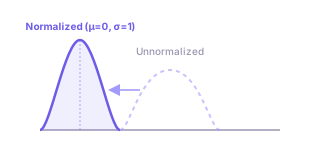
Batch Normalization
How normalization, running statistics, gamma, and beta keep deep network activations easier to train.
Read note →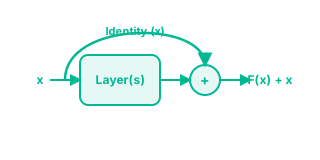
Residual Block / ResNet Intuition
Why skip connections help information and gradients move through deeper networks more reliably.
Read note →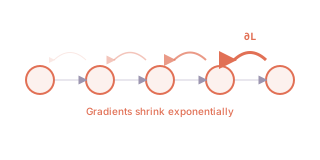
Vanishing Gradient Problem
Why gradients can shrink across many layers or timesteps, and why long-range learning becomes difficult.
Read note →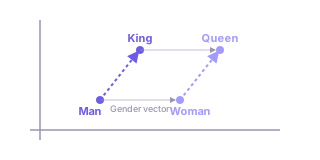
Word Embeddings
How words become vectors that can capture semantic similarity, direction, and reusable language structure.
Read note →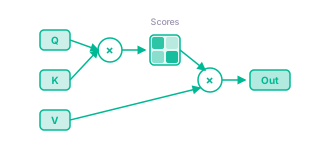
Attention Mechanism
How Query, Key, and Value vectors let a model decide which tokens matter most for the current context.
Read note →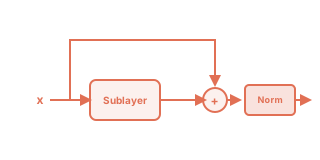
Add & Norm
How residual addition and normalization stabilize transformer layers after attention or feed-forward steps.
Read note →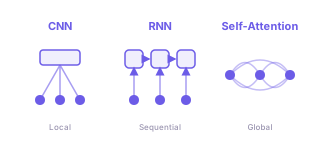
Self-Attention vs RNN vs CNN
Compare how sequence order, receptive field, parallelism, and context flow differ across the three families.
Read note →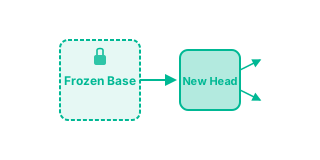
Transfer Learning
How pretrained features can be reused, adapted, and fine-tuned for a smaller or more specific target task.
Read note →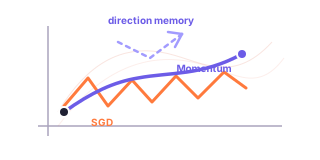
Momentum
Learn how Momentum gives gradient descent memory, reducing zig-zag movement and building speed in consistent directions.
Read note →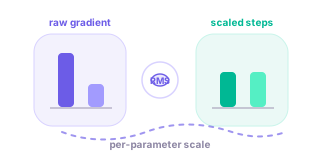
RMSProp
Learn how RMSProp gives each parameter an adaptive step size by tracking recent squared gradients.
Read note →